· Granada is a city and the capital of the province of Granada, in the autonomous region of Andalucía, Spain. It is situated at the foot of the
Sierra Nevada mountains, at the confluence of two rivers, Darro and Genil, at an elevation of 738 metres above sea level. At the 2005 census, the population of the city of Granada proper was 236,982, and the population of the entire urban area was estimated to be 472,638, ranking as the 13th-largest urban area of the Spanish Kingdom. About 3.3% of the population did not hold Spanish citizenship, the largest number of these (31%) coming from South America.
.

· The
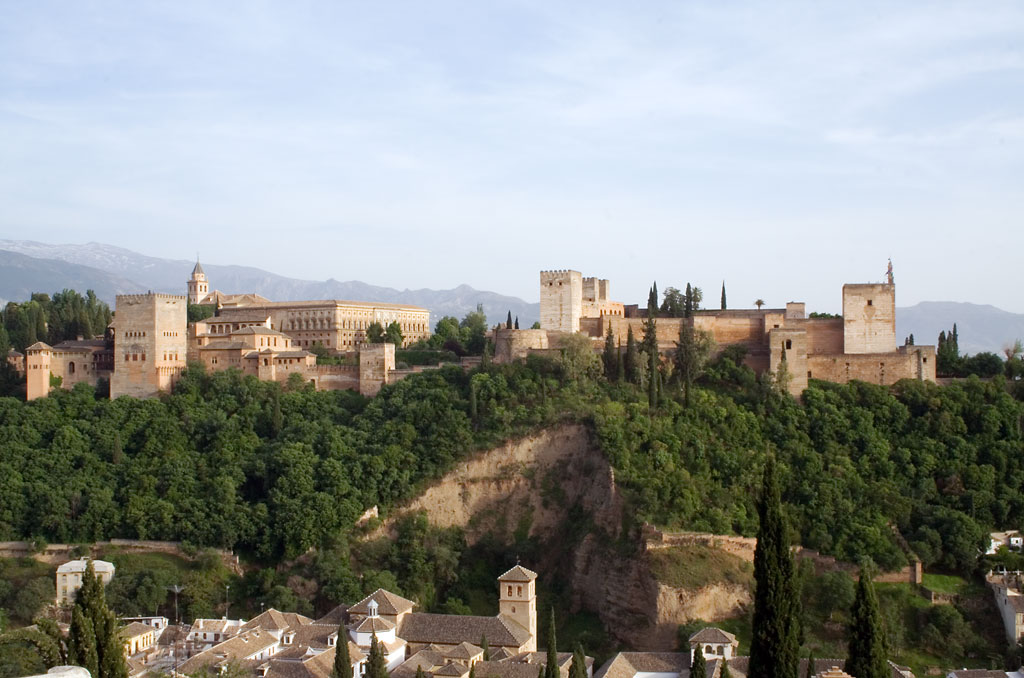
Alhambra, a
Moorish citadel and palace, is in Granada. It is one of the most famous items of the Muslim, Jewish, and Christian historical legacy that makes it a hot spot among cultural and tourist cities in Spain.
·
·The Almohad urbanism with some fine examples of Moorish and Morisco constructions is preserved at the part of the city called the Albaicin.
·
·The Alhambra (Al Ħamrā') is an ancient palace and fortress complex of the Moorish monarchs of Granada, in southern Spain (known as Al-Andalus when the fortress was constructed), occupying a hilly terrace on the south-eastern border of the city of Granada. It was the residence of the Muslim kings of Granada and their court, but is currently a museum exhibiting exquisite
Islamic architecture.
.
. History of Alhambra .
.
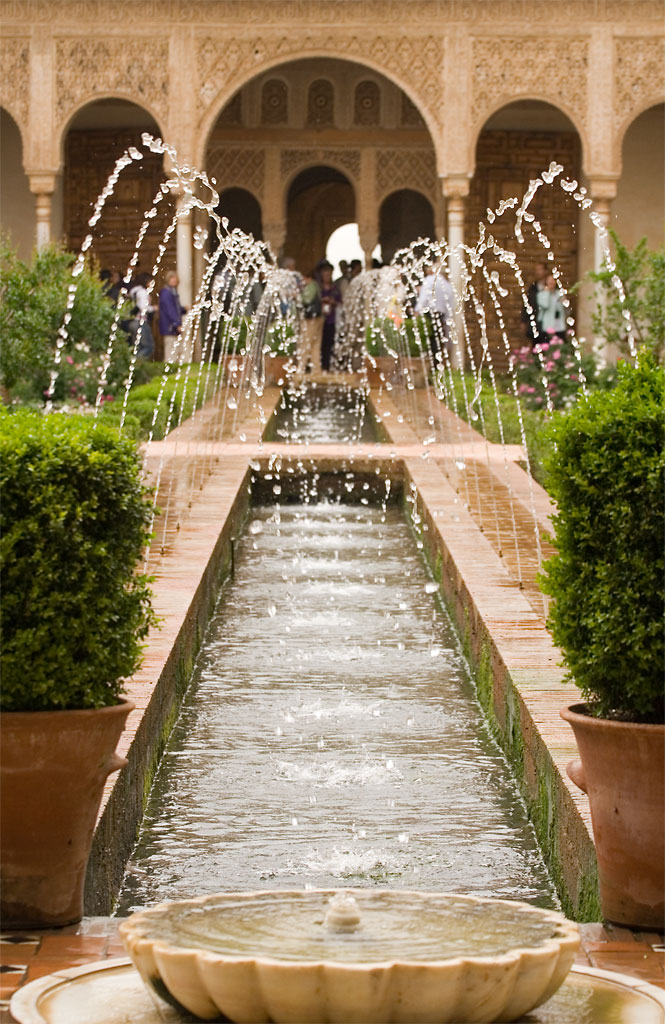
 · The name Alhambra, signifying in Arabic the red (Al Hamra الحمراء), is probably derived from the colour of the sun-dried tapia, or bricks made of fine gravel and clay, of which the outer walls are built. Some authorities, however, hold that it commemorates the red flare of the torches by whose light the work of construction was carried on nightly for many years; others associate it with the name of the founder, Muhammed Ibn Al Ahmar; and others derive it from the Arabic Dar al Amra, House of the Master. The palace was built chiefly between 1248 and 1354, in the reigns of Al Ahmar and his successors, all of the Nasrid caliph; but even the names of the principal artists employed are either unknown or doubtful.
The splendid arabesques of the interior are ascribed, among other kings, to Yusef I, Mohammed V, Ismail I, etc. After the Christian conquest of the city in 1492 by Ferdinand II of Aragon and Isabella of Castile, the conquerors began to alter the Alhambra. The open work was filled up with whitewash, the painting and gilding effaced, the furniture soiled, torn or removed. Charles V (1516–1556) rebuilt portions in the Renaissance style of the period, and destroyed the greater part of the winter palace to make room for a Renaissance-style structure which has never been completed. Philip V (1700–1746) italianised the rooms, and completed his palace right in the middle of what had been the Moorish building. He ran up partitions which blocked up whole apartments. In subsequent centuries under Spanish authorities, Moorish art was further defaced; and in 1812 some of the towers were blown up by the French under Count Sebastiani, while the whole buildings narrowly escaped the same fate. Napoleon had tried to blow up the whole complex. Just before his plan was carried out, a soldier who secretly wanted the plan of Napoleon — his commander — to fail, defused the explosives and thus saved the Alhambra for posterity.________________________________________________

· Granada is also well-known within Spain due to the prestigious University of Granada and, nowadays, wild night-life. In fact, it is said that it is one of the three best cities for college students (the other two are Salamanca and Santiago de Compostela).
·
· With 475 years of tradition, the University of Granada has been an exceptional witness to history, as its influence in the city's social and cultural environment grew until it was to become, over a period of almost five centuries, an intellectual and cultural nucleus in Southern Spain in its own right. It is currently a committed institution which is deeply involved in its setting, as shown in the University Reform Law (LRU), which defines universities as centres at the service of society, by means of teaching, research and the provision of services. In recent years, the University of Granada has faced, under the protection of the LRU and university autonomy, the greatest growth in its history, placing it among the top Spanish universities. Some 80,000 people are directly linked with the University of Granada, among them students, teachers and administrative and service staff.
____________________________________________________
·· The Architecture in Granada ··
.
There are many important Moorish and Catholic architectural sites in Granada:
·Capilla Real. Royal Chapel, with the tombs of Isabella and Ferdinand, the Catholic Kings
·El Albayzín, or Albaicín: The ancient Arab quarter. ·The Charterhouse: One of the most impressive pieces of ornamental Baroque in Spain
·Calle Calderería: An Albayzin street where you can taste Arab typical food, especially teas and desserts from North Africa.
·El Cármen de los Mártires: A lovely palace with a beautiful botanic garden near the Alhambra
·Santa Ana Church: 16th century, Mudejar Style
·San Salvador Church: 16th century, Mudejar Style. With Moorish Almohad patio from the former mosque
·El Corral del Carbón : Deposit of merchandise and shelter of merchants. Adapted after 16th century for theater plays
·Hospital Real: Funded in 1504 by the Reyes Católicos, now part of the University
·Santo Domingo Church: Funded in 1512 by the Reyes Católicos
·San José Church: On the site of the "moans" Almorabitín, the mosque of the morabites, one of oldest in Granada, dating from the 10th century
· Here is the link to the
Official Site for Turism in Granada
· Here is the
newspaper official for Granada [English]
· Here you can see all the
celebrations in Granada in one year.
· Here you have more information:
Andalucia.com Wikipedia Granada· Maybe you want to see a
webcam in Granada.
· And if you want to see the University of Granada, click
here.
___________________________________________________
----
·· My experience in Granada ··
----
· The first thing that I can say about Granada is that the people you are sure to encounter in the streets. Granada is a young city , having the most students of any city out of Madrid (Capital). Just by passing and speaking to the people you get a good perception of the life in Granada. There is a different life here for everybody...It is the young people of Granada that provide the energy and help to ingnite the flames of a time once lived. There are people in the streets that have travelled here to study or have come as far as Africa or Southamerica to work and change their lives. There are also people who have come here for the atmosphere. Granada has a very loving cultural and artistic feel about it. There are so many seclusive, wonderful plazas and parks in which loose yourself within every part of the city.Great for enjoying a breath of fresh air and the brilliant spanish sun.
·
· Three things you must experience in Granada.
1. In Granada the people never seem to pay for their food, The Tappas in the bars and resturants in this city are amazing. For the price of one beer (1.5 euros) you can enjoy anything from a hamburger to a selection of seafood. The tappas is world renouned and atracts alot of the students. Available in most bars and forlunch and dinner.
2. If you are ever in the need of a little Luck, you can take yourself down to the gates of the Cathedral and speak with the wise Gipsy´s and have your furute foretold.The "luck" aparently comes from the leaves of the romero,If you take the leaves u will have all the luck you will ever need.
3. If the "hippie" culture makes you feel at home, you will be soon smiling within dreadlocks guitars and amazing Flamenco Dancers in the street.Also above the city in the "mirador of San Nicholas" you will see the happy faces, music and the best view of "la alhambra"..
.
No more. Kisses. xx
.
David.


 · The name Alhambra, signifying in Arabic the red (Al Hamra الحمراء), is probably derived from the colour of the sun-dried tapia, or bricks made of fine gravel and clay, of which the outer walls are built. Some authorities, however, hold that it commemorates the red flare of the torches by whose light the work of construction was carried on nightly for many years; others associate it with the name of the founder, Muhammed Ibn Al Ahmar; and others derive it from the Arabic Dar al Amra, House of the Master. The palace was built chiefly between 1248 and 1354, in the reigns of Al Ahmar and his successors, all of the Nasrid caliph; but even the names of the principal artists employed are either unknown or doubtful.
 · Granada is also well-known within Spain due to the prestigious University of Granada and, nowadays, wild night-life. In fact, it is said that it is one of the three best cities for college students (the other two are Salamanca and Santiago de Compostela).